Sunday, January 29, 2012

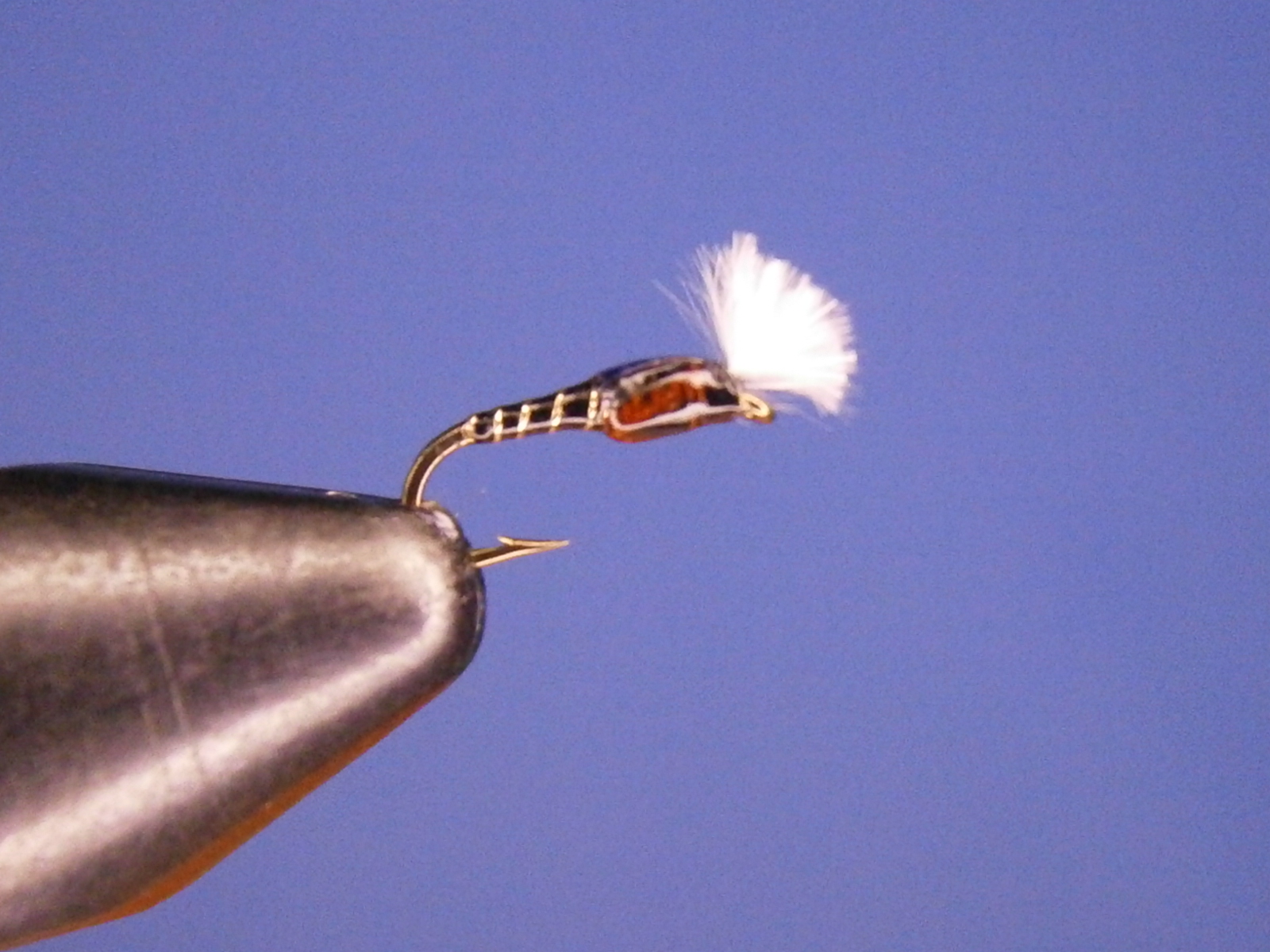
Redesigning the Willow stone

   The willow stone, well, Its not quite mastered yet. Some versions have been quite effective, but I don't just design for effectiveness. I want the fly to be durable as well. I don't want to have change flies because it is coming apart. So after putting the most recent version to test, I decided it needed a redesigning. Mainly the wing, but I also am playing around with different materials for the stripe.  The version below I like a lot. I will be putting it to the test this week.


Saturday, January 21, 2012

A bwo soft hackle for picky fish tutorial and video

  This is a fly I have been using for some time on bwo hatches. It works wonders on picky or pressured trout.  Just quarter down at the trout with it, and get be ready for the strike.  It has been my go to fly for me for years during bwo time on some of the Pa limestone streams such as the Saucon. This fly teamed with a bead wing is just deadly. Its almost unfair.

 Its a quick tie and it certainly isnt anything fancy, but like I said, it cleans up.


Monday, January 16, 2012

The duckfly

This is a duckfly. Its a midge pattern. This one is size twelve.
Materials
Hook- daiichi 1550 #12
Thread- M.F.C. Black 8/0
Rib- Mirage tinsel small
Abdomen- Black pheasant tail
Wing buds- Orange biots
Thorax- Dark Brown seals fur blended with polar pearl lite brite
Breathers- white floss. 

Sunday, January 15, 2012

The bead wing midge emerger

This is the midge I was using in winter session 7. Its extremely effective. I was using one with an olive body.
I use flattened mono to secure the bead. Its really simple and easy to do. The bead will not come off. They are effective when nymphed as trailers, but really shine as droppers on dry dropper rigs for midging trout. Here is the video on how to tie it.

Saturday, January 14, 2012

More Buzzers

Size 20
Been tying buzzers a lot lately. Figured why not go smaller. I enjoy seeing how small i can tie a fly pattern. So far size 26 is the smallest I have tried. 
Size 20

Size 26

Thursday, January 12, 2012

Buzz, Buzz, BUZZERS!!!!

Well I have been playing around tying buzzers since my friends success with one the other day. I have tied them in the past, but as I tied them, I began to enjoy tying them more and more. Here is some of them I tied so far. They are all size 16s


A bead back emerger. recipe and video

This is a little emerger i have used in the past on some bwo and various other hatches with great success.  The fly is a simple tie and well, you can vary the colors all ya want, but this color combo has done me well. The bead on top simulates....well, I dont know, but the fish hammer it, so who cares.
Materials
Bead-11/0 mercury bead.
Thread-Olive brown 8/0
Hook-Daiichi 1550- size to match
Tail- Partridge tail fibers
Abdomen- Turkey tail fibers
Rib- olive hends body quill #35
Thorax- U.V. High Test dub


Heres the video, Enjoy


Wednesday, January 11, 2012

Winter session 9

  Number 9, Number 9, Number 9,  Well got out today to fish before the rains come. We chose a new stretch of stream on a fairly familiar freestone stream.  We started fishing around 930 am and the night cold was still about.  The fishing was slow up to 11am, when some clouds started rolling in and the air warmed.   The fish where very ravenous once the water warmed up to 42F.  Midges where hatching as well as E.B.S.  The fish where on the rise occasionally but my friend and I know the better fish dont rise for E.B.S.. They pick off the nymphs as they make there way to banks or in stream obstructions that are sticking out.

  My friend Josh was fishing a black bow tie buzzer that I gave him from some fly swap i was in. It worked like magic today, beating out the oldie he had in lead.  My fish all came on the U.V. high test hares ear with a black wing case.  It was enjoyable couple of hours for sure as we did catch way "more than four"  Caught a couple of really nice size wild browns, a wild brook, and we even came across a painted turtle.


Tuesday, January 10, 2012

Winter session 8

  Well, got out today with my friend. The fishing was slow in the morning and didnt pick up until late afternoon.  The B.B. sucks!!! The fishing was actually great late in the afternoon with many browns to hand.   Plenty of E.B.S hatching and mating again today. 
  The golden oldie was the top producer followed by the U.V. high test hares ear.  The peeking caddis accounted for a couple trout as well did the bead wing midge. This is the same midge I used in winter session 7. I will have a video and post on it very soon. I figured out a way to keep the bead on it and its bomb proof.


Wednesday, January 4, 2012

Rubber Diamond Ducky with tutorial.

Rubber legs are everywhere I look. There on pretty much any fly you can name. A friend of mine fishes rubber legged flies often, and I do see there effectiveness. So I figured I would put together some rubber legged nymphs together. I wanted a rubber legged trailer fly and so the Rubber Diamond Ducky was born

 Click read more for the tutorial

Saturday, December 31, 2011

Chapter 12, a series of fly pages

Image
Chapter 12 page 24. Page 24 is the original tie of the chapter 12, it has a chartreuse and black life flex body.

Image
chapter 12 page 30. chartreuse and purple with a black under body. This one tied with a grey under body will make the colors much brighter. Head only had one coat of varnish.

Image
chapter 12, page 31 purple and fluorescent pink with a grey under body.

Saturday, December 24, 2011

The Frostbite chironomid tutorial, and season greetings.


Seasons Greetings Everyone!
  The origins of this fly is unknown according to the book Modern Midges. However it is extremely similar to the Brian Chan's Frostbite Midge.  I am sure there is some story there, but what it is, I dont know.  I will say it is an effective pattern for sure. Its a simple tie and can be tied in different colors. Size range from a 14 to as small as you tie them. I like the in size 18-22.
Lets twist one up.
Click the read more link

Tuesday, December 20, 2011

The NPA midge tutorial and video


 This is the NPA chironomid. The NPA was devised by someone at the North Park Anglers.  Its a simple and effective fly. Can be tied in range of colors and sizes. Black, Olive, Red, White, in sizes 12-20. You can go smaller with them if you wish. I like them in size 18-20.

Lets twist on up
Daiichi-1170
Thread-Red utc 70
Rib-Fine silver wire
Thorax- Peacock hurl
Wing case- White antron
Breathers- White antron
Click the read more for the tutorial and video

Monday, December 19, 2011

Big Mac Tutorial and Montana Mac video

   
A big mac pile, with Montana Macs mixed in.
  The Big mac pupa was devised by John Tavenner. He is a guide, fly tier an fly designer out in New Mexico. He has developed many patterns that are now the bread and butter on the San Juan. Here is John's site. http://www.sandstoneanglers.com/

  The Big Mac is an effective pattern, that works great on limestone streams, as well as tail water fishers.  The fly can be varied in colors and ribbing in between the micro tubing. You can let your imagination run wild with this pattern.  The sizes i find to be effective are 18-22. #16s will work as well.


Lets twist one up

Thursday, December 15, 2011

Johnny's Amnesia Midge


Here is a creation of mine. It works well on rainbows and brook trout. It eve will catch the occasional brown trout. Its pretty simple to tie, just gotta find some amnesia mono in red. Sun Set is the name of the company who made it.

 Materials
Hook- Daiichi 1275 #16
Thread- black 8/0
Body- Silver holographic tinsel
Rib-Red Amnesia mono15lbs
Collar- Bronze peacock hurl

Lets twist one up!

Wednesday, December 14, 2011

Jack-o, The Mad Man, and wild trout.

  Well, Got out for some flying today. A good friend by the name of Mad Man Steve, came on over to the fly corner. After we b.s.ed a bit, we headed on out to my favorite spring creek.  We got out on the water around 130ish. We picked a section and tied on some nymphs. I tied on the U.V. high test hares ear with hot spot, trailed by the Jack-0 pupa.  The Mad man tied on his hares ear/pheasant tail (awesome fly) followed by a yellow partridge and biot, that i had given to him on our last fishing adventure, to that god awful pequest tca.  We caught more than 4 and the nymph went like so, Jack-o won it, hares ear runner up, partridge and biot a respectable third.

Does the Jack-o pupa work? This trout and several others say YES!

Click the read more for more photos

Tuesday, December 13, 2011

The Jack-o pupa tutorial and video

 The Jack-o pupa. Just a little something I whipped up that the fish dig. (I like it too)  Special thanks to George over at wildfly365
Johnny's Jack-o pupas
Lets twist on up!
click the read more link to the bottom right

The Stupid Midge aka stripped hurl and peacock

 The stripped hurl and peacock as its called in Ed Engles book Tying small flies.  It is called the stupid midge in Takahashi & hubka book Modern midges.  The origins of the fly are unknown.

 Call it what you want, its an effective midge pattern. The quill body is a very life like imitation of the real midge larva and pupa. It has caught me trout when no other midge would.  It will always have a place in my box.
  They are a quick and easy tie. I find sizes 16-24 to all be effective. 


Lets twist on up.


Friday, December 9, 2011

Johnny's Musky midge

  
  My muskie midge was devised a couple of years ago and is my secret weapon on the musconetcong midge hatches. There is a midge which hatches all year long that has an olive body, grey wings, and a red head, or at least its eyes are red, but they are so large on the bug that they take up the whole body. This midge isnt limited to the musconetcong river system, I have seen it all over from freestone to lime. The fly is effective for eastern Pa midge hatches as well.   This fly is where the muskrat/sts grey blend originated.     The design is of an al's rat(Miller) and a sparkle midge pupa(Borger).  I dont tie it any larger than a 22. The naturals of this midge are tiny. I do well with 22-26. 
Lets twist one up!
Click the read more link for the tutorial


Thursday, December 8, 2011

Winter midges, Al's Rat


  Al's Rat, is a simple and effective midge pattern you can get. It was devised by the late Al Miller of Pa. He fished the Little Leigh every day. The pattern was designed to imitate the many midge pupa found in this river. It is a fantastic midge pupa any where. Al was a great man and one hell of fisherman. He believed in the theory and design methods of tying in the round.  This of coarse means that all sides of the fly are the same, no matter what way you look, the fly is the same.  I dont limit this pattern to winter. I fish it all year long. 

Wednesday, December 7, 2011

Rainy days, a fly legend-The quill gordon.


  Well, its raining here in great north east....again! So much rain this year, its rather remarkable for sure.  With the rain falling I decided to stock my plates with a fly of what is now becoming legend. The quill Gordon.  Theodore Gordon "The father of dry fly fishing" is credited with its creation. Although he never mentioned it in his writings, he only mentioned the "blue quill gordon". Perhaps that what he called the quill gordon.  Never the less Theodore Gordon was an amazing fly fisherman with a wealth of knowledge. Unfortunately he didn't like to share!  However he did make a great impression on the sport and art of the fly. He did leave us with a great legacy of  the Catskill fly tier. Ok enough of the history lesson.

  The quill Gordon to me is a deadly fly February right through mid April.  I tie them 3 ways. Catskill, Wet fly, and Parachute.  I use the catskill in the riffles, the parachute on flatter waters and the wet fly any where.  The wet fly is a great producer in the late winter and early spring. With a great deal of takes coming on the end drift swing and hang.  I tie the wet in sizes 12-18, with 16 being my most commonly used. The dries, I tie them in 14s to 18s. I haven't seen a larger one then a 14 in my area.

  The nymphs of this fly are clingers, they are commonly found in shallower riffles, and other areas of swift moving water.  The trout can found in these areas at hatch time, a good number of trout will also sit in the transition from riffle to run or to pool, and wait for the duns to come riding down in the film.  The nymphs hatch on the bottom and in the water column on the way to the surface. This why the wet fly is important.      

Now the fun part, Lets twits some up! This tutorial will be for the wet fly. I will do the dries in upcoming tutorials.


Tuesday, December 6, 2011

U.V. High Test Hare's Ear

pearl, black, chartreuse, and pink

The U.V. High Test hares ear, is my hares ear tie.  This is my lead  fly when i cant use the oldie due to the oldies weight.  It produces quite well. I have posted about in my fishing reports.  I use my u.v. high test blend for the dub, thus the name.

 I like to tie them with brown partridge legs for color contrast. But regular partridge works well also.  The wing case is Flat diamond braid. The black works particularly well. I also do them with pearl, chartreuse, and pink wing cases.  I coat the wing case with either Loons U.V. fly finish, or I use Aleene's Fabric fusion.  The rib is a small holographic gold tinsel, and a utc extra small wire.  For the tails i use wood duck but sometimes i use mallard. Bronze is nice because it complements the legs.  The fly holds up extremely well fish after fish.

 I am a Daiichi hook fan, and have been for time. I recently picked up sponsor for my blog. J.W. Trout.  He has fantastic deals on Daiichi hooks. Click on his link to the right and check out the savings.  For my U.V. high test hares ear I like the 1550 or the 1560.


Lets twist one up!


Bead on hook, 5-7 wraps of .015 lead pushed up behind the bead. Start the thread and run it back to about the barb. Get a small clump of wood duck flank.

Tie in the tail

Tie in the tinsel with one wrap

Tie in the gold wire and bring the thread to the bead, tying in the tail, tinsel, and wire. Bring the thread back down to just before the tail tie in point.

Dub the abdomen, Dub tightly, and make a nice carrot shape.

Bring the tinsel up through, nice evenly spaced turns.

Bring the wire up, wrap it right on top of the tinsel.

Tie in the diamond braid on top of the hook, bring the it back to about half way on the shank.

Dub the thorax, Dub loosely so it can be brushed out easier.

Get a partridge feather and cut the tip out. This is great for burning up those big partridge feathers.
Bring the feather so the end are on both sides of the fly, check the length, i like them to be to about the barb, any shorter and they just get caught up in the shaggy dubbing. Pinch them at the length, and take a few tight wraps over the butt end.