Showing posts with label pa fly fishing forum. Show all posts

Monday, September 19, 2011

How to make custom dubbing blends.

Hello fellow tiers!!!!

Making dubbin can be fun. It is a great way to make blends of your liking. If you have ever seen a real insect than you know that they are not a consistent color. It doesn't take much, just a simple electric coffee grinder will do the trick. Furs from any animal. Yarn of just about any kind. Even marabou (AWESOME DUBBING)

For furs my personal favorites are rabbit, both mask and body hair. Body under fur is one of the softest and easiest dubbin around. When treated with a water proofing agent ie floatant it will float all day. Body fur with guard hairs makes awesome nymph dubbing that is extremely easy to dub. Squirrel of any variety. Squirrel makes great spiky nymph dubbing. Australian opossum is great nymph dubbing. Seals fur is great emerger dubbing. Which really goes well in dubbing blends. Muskrat is great nymph dubbing and also dry fly dubbing. Beaver makes great dry fly dubbing as well. 

Yarn of just about any sort. Check out whats on sale at the craft store or mega stores and pic out some colors you like.Its very easy to make yarn into dubbing. You can get wools and synthetics. Synthetics in the craft world they are acrylics.

Marabou from feathers and actual marabou makes some awesome dubbing. When you pluck those hackles don't just throw away that butt or strip it away. Instead cut it away. Store them in a bag or container and when you have accumulated a bunch simple trim the marabou from the stalk. DON'T strip it or you will up with the stems skin, which will not blend or dub so well.

Flash materials can be picked up via yarn or just picking up some packets of ice dub, polar dub, sts, antron and so on. My favorites are ice dub u.v., polar dub, and sts. The bags you get will make tons of blends. So they are well worth the couple of bucks.

General materials list.
1- Electric coffee grinder. Wally world has a great one and its cheap.
2- Scissors.
3- Fur, yarn, Marabou, Flash materials.
4- dryer sheet or static guard- this is to help with static cling, not necessary but very helpful.
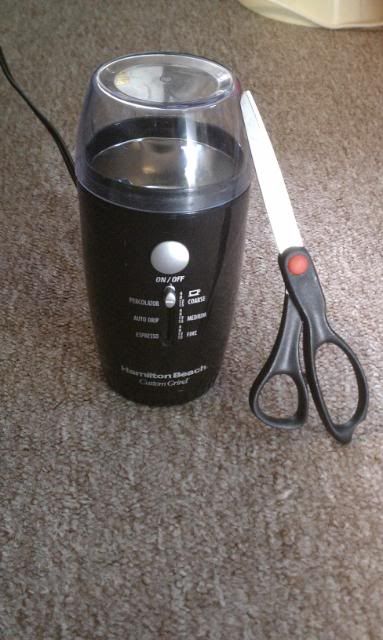
Tools. The coffee grinder is a wally world one, works excellently. I like the large scissors as you can get more with just a cut


Ok lets do a blend! This is one my favorites, its a great olive blend for caddis and various nymphs
Image
Materials-caddis green polar dubbing, an olive hare's mask, and caddis green sts

Image
Cut a small amount off the hares mask. If you want extra coarse dubbing cut in some ear hairs.
Image
load it into your grinder, and give it a few pulses of about the count of 1,2 and stop. Repeat. It will then look just like dubbing in a bag, but fluffier. This will help us add the flash materials. The grinder will chop up your fur if you let it run to long.
Image
Take out about 3-4 pinches of flash, about this much will do nicely. Add them to your hair that you have blended. Just dump the sts right in. Its a short cut dubbing so it will come apart and blend easily. The polar dubbing is a long cut dubbing. You will need to tease it out and put it in. Once you have them all in, give it several pulses of 1 and 2 and stop. Any time you use synthetic in your blender never blend to long or will end up with little plastic balls.

Image
The result. A buggy, flashy but not to flashy, easy to dub blend :D
As you can see it is quite simple. Have fun creating your own custom blends.

Tight Ties
Johnny Utah

Tuesday, September 13, 2011

Wild trout steam report 9/13/11

Well after getting some fly orders tied and in the mail. I met up again with Mr. George from Wild Fly 365. We hit my local spring creek for some wild brown action. The creek is still flowing high, but the water is clear once again. We nymphed, and worked are way up stream. We fished about 1/10th of mile of the stream.  We got into browns rather quickly. Mr. George was using a Golden Oldie and his hybrid hares ear. I was using the Golden Oldie followed by an improved zuggy. I love zug buggin. Hands down the oldie was the winner. The zug got a few.

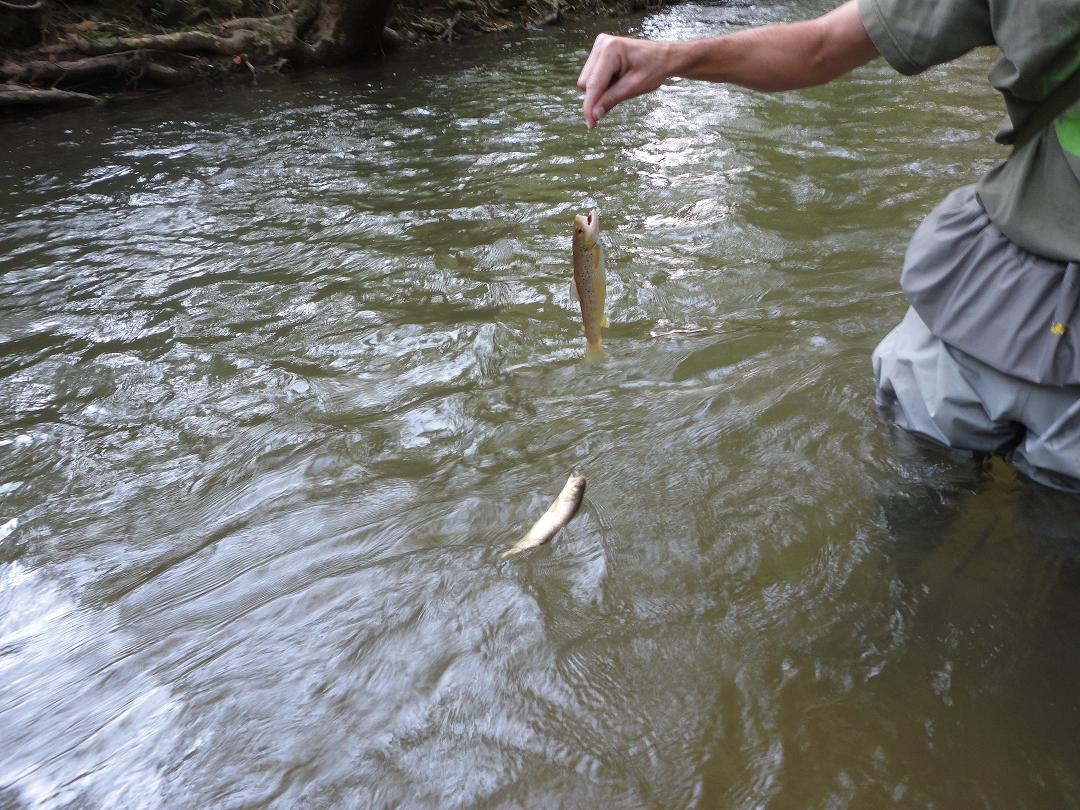
I got two wild browns on at the same time. One on the oldie and the other on the zug.  Needless to say I was rather surprised as I haven't done this with wild trout before, stockies a couple of time, but not wild.  Mr. George got a picture of it.

Several of the trout we caught came on the lift.  We noticed some mayflies hatching sporadically. There wasn't enough to get the fish up, but it would seem they were keyed in on the emerging bugs because the lift worked well.  With "more than four" and stomachs complaining, we headed back to the vehicles and off to Charlies Pool Room for the best hot dogs in existence!

Saturday, September 3, 2011

A Throw back and a lesson remembered

I did a video of an old pattern. One that has caught myself and so many others so many trout. I did the old school ant, but of coarse I used synthetic dubbin. I tied up a batch of Cinnamon ants, because I am going to fish a spot on a spring creek that I know the trout there get a regular diet of cinnamon colored ants.

Ants of this color are always small, well at least were I am from. They usually are between a 22- 26. I tie them in size 28 as well. If the trout are being picky, the smaller sizes are required.  In the video I tied a Huge one so the video would be clearer. I also tie these tiny ants in dark brown. This color represents the common ants that you see all the time. Yup they to fall in the water and become pray to the trout. The browns I tie in the same sizes.

I need to fire up the dye bath, to dye some tiny hackles red. There is an ant, one I have only ever seen on two streams. One in New Jersey and the other in P.A.. The body on these ants is the same color as trico, a super deep brown, pretty much black. The kooky thing about them is they have bright red legs. Weird looking they are for sure. But the trout are aware of them and they do look for them. I discovered these ants one July morning some years ago. I was fish the trico hatch and there was a rather large trout sipping occasionally. He was my last trout catch, I got the others, and put the rest down from catching them. I drifted my trico over that trout several times without even a look. I swapped patterns, going through my trico arsenal, and nothing.

I stood and watched the trout feeding. The rises were not in any kind of timing, but they were sipping rises just like the trout was taking spinners.  I got my binoculars out of my car and peered at the film, I could see trico spinners, drifting right over the trout.  I noticed a smiggin a extremely small bug on the water, smaller than the tricos. The trout came right up and took it. I thought hmm perhaps it was a midge or maybe an ant. I tried a griffiths gnat #26, the trout looked but no take. He didnt look again. I swapped out for the old timely cinnamon ant. I tied the size 26 ant on the line and cast it over him, it came into his window and he came right and sipped it right in, or so it appeared. Once I got the trout in, I saw he was fowl hooked. By chance i managed to hook him on the top of his head. Hey you try and keep track of a size 26 ant 15ft away. lol

 Once he settled and I removed the hook from his head, I pumped his throat. I had to see what he was eating. To my surprise, I pumped out a mess of the dark, red legged ants, and just a couple of small cinnamon.  I have a huge arachnophobia, I mean I will scream like a little girl when a big spiders on me. When i pumped the throat load on my hand, I could of swore those little ants were spiders. I nearly threw it right in the stream.  Upon closer inspection i noticed only six legs, but they were red.  I went home and picked a mess of hackles off the white neck i had and dyed them red.

Two weeks later later I returned to this stretch of stream with my hatch matching ants. I thought well they should work.  I had tied a couple up parachute style and a couple the old way. I tried the parachutes first. Not even a look. Hmmm. I put a trico on and started catching fish.  I got down near the area where I had the run in with that selective trout. A couple of trout were rising under the large sycamore. I watched the fish for a short while. I noticed one rising that was certainly larger then the rest. I set my trico a drift to him. He refused it. I tied on the old school red legged ant. Sent it a drift, and nose up, dorsal, tail, he was one. A great fight with a 17" wild brown. After I released him, I made my way back up to the fish that refused he parachute. There were some which didnt want my trico, and I wondered if they would take the ant.  I got every one of them with it, one the first drift to them. From that day on, I always carry red legged ant, tied the traditional way.

Heres a video of the traditional fur body ant. As I said earlier, its a large cinnamon. I tie the red legged ants to small for video. And I dont have a pic because as I stated earlier, I need to fire up the dye bath and dye some size 26 hackle red.

Sunday, August 28, 2011

The Floating Nymph

The floating nymph is an essential fly for every fly box. Its possibly the deadliest emerger pattern. These patterns should be in every dry flyers arsenal. There are several species of mayflies which the nymph floats in the film while the dun emerges. So there is a time in there emergence when the nymph is just riding in the film. The trout love emergers, and they will feed on them exclusively. Not only is it a great hatch matcher, Its also a fabulous searching pattern. If trout are rising and I dont have a clue what they are eating. I use either a floating nymph or an ant. I havnt met a stream yet that its not deadly on the trout.

My favorite floating nymph is the floating pheasant tail nymph. Yup even floating the the pheasant tail nymph is still deadly. Other floating nymphs I like to use are thread body ones. They will sit right down in the film and there simple and quick to tie.

As I write this Irene is a blowing away, shaking my house. Hope the old girl holds up. Major amounts of rain have fallen already. The tri-state area is flooded for sure.

Heres a video of how to tie one with a post for a wing. Its a parachute pheasant tail nymph. I will do a video of the other parachute post method. Both are effect ties. Check it out and please subscribe or follow me, I will have many more videos to come.


Wednesday, August 24, 2011

U.V. Resins Review. Clear cure goo, bug-bond and clear cure fly finish.

Photobucket

U.V cure resins.
 The introduction of these product to the world of fly tying has made a major impact. They hold 1 great advantage over epoxy and that is the cure time. Each one cures in a matter of seconds. Other advantages are no mixing. No in between time to get the resin on and cure it. Because you use uv light to cure the product, you have limitless time to shape, spread and coat your creations.
I use these products for making cases on nymph backs, doing "epoxy back flies", and for coating fly heads.

 One of my patterns in particular uses the resin over the entire back of the fly. I used this pattern to test out each of the resins. I fished the pattern with each product on them for 4 weeks straight,(total 12 weeks) and got results that I want to share with everyone who cares to read my blog. I will cover price to product quantity, performance, ease of use Ie containers and applicators, and availability.

 There are 3 competitors in this market of new interest to fly tiers. They are loon uv clear fly finish, bug-bond multipurpose uv cure resin, and clear cure goo aka c.c.g. I think everyone knows of the company loon. Loon as you already know or may not know is an excellent company. There products are well researched and come at good prices. Bug-bond is a relatively new company. Based over seas in the U.K., from what I can tell they are only in the u.v. game. Clear Cure Goo, is also a relatively new company. They popped up in recent years and are being pushed hard as a U.S. based company. They push there product mainly as a salt water fly product. But they also promote fresh water applications.

 Here are the numbers for cost and quantity. All prices are full retail price. And I listed them in order for most product for the best price.

 Loon- 59.15 ml for $22.88- Loon does not have a kit available. There light retails for $34.95 but you can find it cheaper. So your looking at a possible kit of $57.83.

 Bug-bond- 20ml for $25.50 at white water flies. There kit goes for $47.95. The kit comes with a 20ml bottle and a u.v. light. Bug bond also makes a power light. It is much more powerful than the light which comes with the kit. They call it there uv torch. It retails for $57.73 and I believe is only available in the U.K.**** update, white water flies now carries the torch light, you can even get it in a kit.****

 C.C.G.- 10cc/10ml syringe for $13.50. They have a 15ml bottle for $17.00. There kit retails for 49.99 and it comes with two syringes so you get 20mls and you get there light. There light retails separately for $30.00.

 Summary- Its quite simple to tell that Loon crushes the competition with 59.15ml@ $22.88. compared to bug-bond at 20ml@ $25.50 and c.c.g. at 15ml@ $17.00.
Loon- $0.39 a ml
Bug-bond- $0.79 a ml
Clear Cure Goo- $0.88 a ml

Here I will cover ease of use and availability

 Loon- The resin is very easy to work with. The bottle is large and is easy to handle. It sits perfectly up right and is easy to have on your bench. A brush of okay quality is included as well as a cap to make the bottle a squeeze bottle. The brush works well for large jobs, and the squeeze bottle adapter is very convenient for the small jobs. Both the brush and the squeeze bottle applicator screw on to the bottle. Loon can easily be found on-line and in many fly shops across the country.

 Bug-bond- Bug bond resin itself is very easy to work with. The bottle is a small to medium size bottle that is easy to work with and easy to keep upright on your tying bench. The bottle itself is a squeeze bottle applicator. You simple snip the tip and your ready to start. The brush is a screw on cap for the bottle, and the squeeze bottle tip is apart of the bottle and the cap screws on securely to cover. They also make a brush applicator that is an okay brush. And it is the same as the loon. Bug-bond is a product of the U.K. so its availability in the U.S.A. is very limited. Although a quick search on line and you can find it, with free shipping to boot. I am unaware of any actual store front fly shops that carry bug-bond here in the U.S.A.

 Clear Cure Goo- Clear cure makes several different consistence of resin. Each one is easy to use and work with. The syringe are very uncomfortable to use and next to impossible to store or keep on your bench. There bottles are small. They are easy to use, store and keep on your bench. They have several different application bottles, there is one with no applicator, the method would be to use your bodkin. They make a squeeze bottle applicator, which is nice and easy to use. They also make a brush applicator bottle. The brush is the same story as the loon and bug bond. The syringe and the squeeze bottle have a little rubber cap to cover the application tip, it does not screw on. C.c.g. is taking the country by storm. You can find the product very easily on-line and and many fly shops are starting to carry the product.

 Summery- Loon's bottle has it all in one, and is easily found. Bug-bond's bottles either come with a squeeze (very nice) or brush, and is not so easily found here in the U.S.A. C.c.g. syringes are very inconvenient. There bottles are nice and you either get a squeeze bottle(nice) or the brush bottle or no applicator bottle. The rubber caps to cover the tips are easily knocked off and do little to keep excess goo form oozing out.

 Here I will cover the performance of each product. I cured each product with there own light and fished the pattern fly for 3 weeks straight. Bouncing bottom the whole way in the rocky streams of eastern pa and western N.J. (yes, it got snagged and yes I went swimming. Brr was that cold in the winter)

 Loon- Loon cures is fully cured in under 8 seconds with there power light. It adheres to nearly anything. Goes on clear, cures clear with no residues. In my fly testing loon performed flawlessly.

 Bug-bond- bug-bond cures fully in less than 5 seconds with there torch. 10 seconds with the standard light that is included in the kit. It will adhere to almost anything. Bug-bond when cured has a slight residue left behind. It is not sticky and will evaporate in a short time. About the time it takes you tie another fly. In my fly testing bug-bond performed flawlessly.

 Clear Cure Goo- C.c.g. cures in less than 10 seconds with there light. It will adhere to almost anything. C.c.g. when fully cured does leave a residue behind. It's slightly tacky, so dubbin particle will adhere. It doesn't seem to dissipate in any quick fashion. This is true for both the thin and thick. The flex cured with a slightly oily residue, not sticky at all, very similar to bug-bond residue. In my fly testing c.c.g. had problems. The flex came clean off the nymph. Both the thin and the thick turned white after only a 2 days.

Summary- Loon performed great, as well as Bug-bond. C.C.G. didn't do so hot.


 I hope this helps anyone who is interested in purchasing u.v. cures. My results say much about the companies and there product. While I do like bug-bond a lot, I will be sticking with loon clear fly finish. That is if I ever finish the bottle. 59.15 ml has lasted me many dozens of flies and I think I may have finally put a dent in the bottle. As for c.c.g. I say buyer beware.

Tight Ties
Johnny Utah.

Additional info- I have continued use of the u.v. resins. Still working on finishing that loon bottle! I recommend with all the resins you give them more cure time. The times i listed above are all manufacture cure times.  I have found that each one does take additional u.v exposure to fully cure. 

 1/18/12  I have a bottle of bug bond thin on the way, and will be purchasing the c.c.g. hydros to test out through the next couple of months. I will report back the details.